
$1 Trillion in Invisible Labor: What the 2026 AARP Caregiving Report Means for Your Family
Right now, somewhere, a daughter named Rachel is getting her mom dressed before her own shift starts, and no one is counting the hour she just spent. Multiply that hour across the country and AARP puts a price on it: $1 trillion a year. That is the value of unpaid family caregiving in the United States, and the reason it matters to your family is that the same math, scaled down to one household, tells you what this work is costing you and which programs were built to pay some of it back.
The number is $1 trillion. That is what AARP's 2026 "Valuing the Invaluable" update calculates as the annual economic value of unpaid family caregiving in the United States. To put that in scale, it is more than every government in the country, federal, state, and local combined, spent on Medicaid in 2024, which AARP pegs at about $932 billion. And none of it shows up on a paycheck or a W-2.
Behind the trillion-dollar figure sit the people doing the work. Let me show you what the report counts, then bring it down to the only scale that matters at your kitchen table: one family, one year.
What does the 2026 report actually count?
Three numbers carry the whole report. They are big, abstract, and easy to skim past, so here they are one at a time:
- Americans who provided unpaid care to an adult family member or friend in 2024.
- The total they logged over twelve months.
- The value AARP now places on a single hour of that care, up from $16.59 a few years ago.
Those numbers are useful for policy debates. The question that matters in a single household is simpler: what does this actually cost one family?
What the trillion-dollar number means for your house
- AARP values each hour of family care at $20.41, so 35 hours a week is roughly $37,000 a year.
- Cutting back at work shrinks today's pay and tomorrow's retirement.
- Nearly every state now runs a Medicaid program that can pay a family caregiver, and the VA has its own benefit.
- A written caregiver agreement now can prevent a Medicaid penalty later.
What does caregiving cost one family in a year?
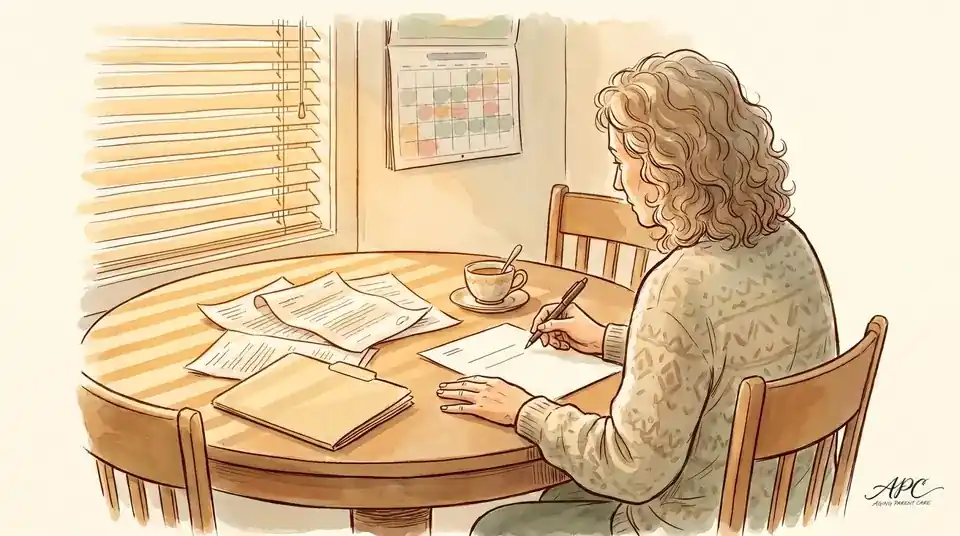
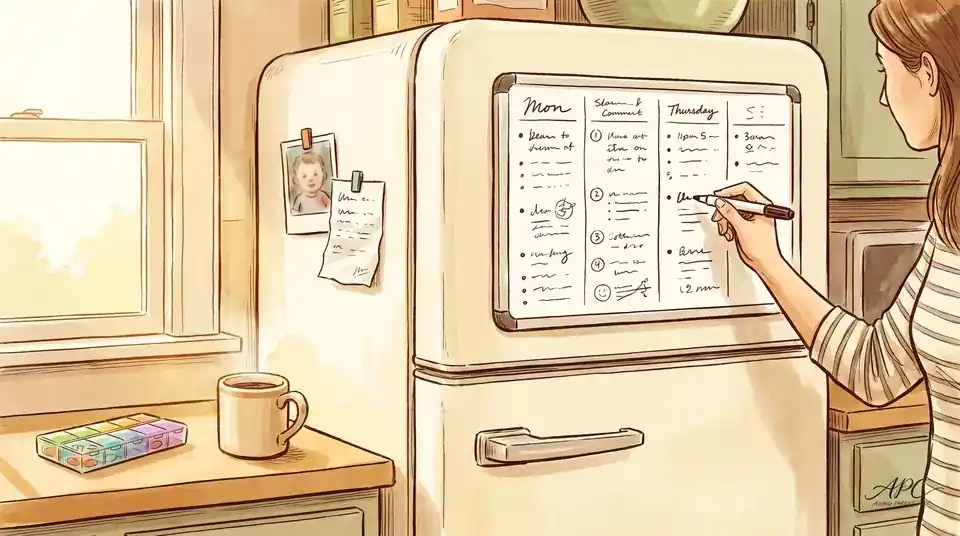
Rachel is 47. She lives in Mesa, Arizona, and works as a dental hygienist. Her mother, who is 79 and has moderate vascular dementia, lives in a casita behind Rachel's house. Rachel gets her mother dressed each morning, prepares meals, manages her medications, drives her to appointments, handles her insurance paperwork, and stays awake the nights her mother wanders. Her mother still picks her own outfits, still wins most arguments about dinner. None of that work shows up anywhere a paycheck would.
A conservative estimate of Rachel's caregiving hours is 35 per week. At the AARP valuation of $20.41 per hour, that is $37,146 a year in uncompensated labor. Over five years, the total reaches $185,730.
Before the numbers pile up the way they did for Rachel, the free Aging Parent Care Starter Kit walks you through the first steps in plain language, at your own pace. Get it sent straight to your inbox.
Send me the free Starter KitThe money she is losing today is also money she will not have at 67. The real cost runs deeper than the hours. Rachel dropped from full-time to part-time three years ago. That cost her roughly $18,000 in annual wages, plus the employer retirement contributions that came with the lost pay, plus the growth those contributions would have earned by the time she retires.
Why is so much of this work invisible?
The AARP data confirms what many caregivers already describe: the caregiving economy runs on the unpaid labor of people who cannot afford to say no. The employment picture shows the squeeze. Of the family caregivers who are juggling a paid job alongside the care, here is what the work side looks like:
- Most caregiving happens on top of a work schedule.
- Care time gets carved out of paid time.
- Careers stall while the caregiving continues.
- For some, the two roles stop fitting in one life.
And the isolation is real, not imagined. Nearly one in four caregivers say they feel socially cut off, a share AARP reports is growing.
The out-of-pocket side adds up too. Family caregivers spend around $7,200 a year out of their own pockets. One in three dips into personal savings to cover it, and about 12 percent take out a loan or borrow from family or friends.
The work is invisible because it never lands on a paycheck. Naming the number is what turns it into something a family can plan around.
What can a family actually do with these numbers?
The figures are heavy, but several of them point straight at practical moves. Here are four worth making this month:
- Keep a simple time log for two weeks, then multiply the hours by $20.41. The number will be uncomfortable. That is the point.
- Nearly every state now runs a Medicaid self-directed care program that can pay a family member to provide care, and the VA's Aid and Attendance benefit can add up to about $2,358 a month on top of a single veteran's pension.
- A Roth IRA (the 2026 limit is $7,000, or $8,000 at 50 and up) lets even small contributions compound over twenty years.
- A simple caregiver agreement can prevent a costly Medicaid denial later. One piece of paper now could save tens of thousands.
Rachel does not think of herself as part of a trillion-dollar workforce. She thinks of herself as someone who loves her mother and does not have much of a choice. Both things are true. The math is also true, and naming it is what turns it into something a family can plan around.
Frequently Asked Questions
How did AARP get to the $1 trillion figure?
AARP multiplied the estimated hours of unpaid care by an hourly value. The 2026 update counts 59 million caregivers logging 49.5 billion hours at $20.41 per hour, which lands the annual total at about $1.01 trillion.
Can a family member actually get paid to provide care?
In many cases, yes. Nearly every state runs a Medicaid self-directed or consumer-directed care program that can pay a family member, and the VA's Aid and Attendance benefit can raise a single veteran's pension by up to about $2,358 a month. The rules vary by state, so confirm what applies where your parent lives before you count on it.
Why does a written caregiver agreement matter?
If your parent later applies for Medicaid, money that moved between family members can look like a gift and trigger a penalty. A simple, dated caregiver agreement documents that the payments were wages for real work, which can prevent a costly denial down the road.
Family caregiving is worth $1 trillion a year precisely because it is unpaid, and naming the cost in a single household is the first step toward the programs built to offset it.
Related from Aging Parent Care
- Caregiving Financial Help for Lower-Income Families
- How to Build a Care Team When You Are the Only One
- The $5,419 Question: Home vs Facility
Sources
- AARP Public Policy Institute. "Valuing the Invaluable: 2026 Update, The Economic Value of Family Caregiving." AARP, 2026. aarp.org/pri/topics/ltss/family-caregiving/valuing-the-invaluable-2026-update
- AARP. "Economic Value of Family Caregiving Reaches $1 Trillion Dollars Annually, New AARP Report Shows." AARP Press Release, March 26, 2026. aarp.org/press/releases/2026-03-26-AARP-Economic-Value-Of-Family-Caregiving-Report.html
- AARP and National Alliance for Caregiving. "New Report Reveals Crisis Point for America's 63 Million Family Caregivers" (Caregiving in the U.S. 2025). AARP Press, July 24, 2025. aarp.org/press/releases/2025-07-24-new-report-reveals-crisis-point-for-americas-63-million-family-caregivers
- AARP. "The Overwhelming Financial Toll of Family Caregiving." AARP, 2025. aarp.org/caregiving/financial-legal/financial-impact-caregiving
- KFF. "Medicaid's Home Care Support for Family Caregivers in 2025." Kaiser Family Foundation, 2025. kff.org/medicaid/medicaids-home-care-support-for-family-caregivers-in-2025
- U.S. Department of Veterans Affairs. "2025 Veterans Pension Rates" (Aid and Attendance maximum annual pension rates). VA.gov. va.gov/pension/veterans-pension-rates/past-rates-2025
© 2026 Aging Parent Care. All rights reserved. No portion of this article may be reproduced, distributed, or used in any form without the explicit written permission of Aging Parent Care.
Where to go next
- How to Talk to Your Parent About Incontinence Without Shame
- The Family Code Word That Stops AI Voice Scams Cold
- The Free Starter Kit Every New Caregiver Should Get First
- How to Get Power of Attorney for an Elderly Parent, Step by Step
- What Does Caregiver Burnout Feel Like? 7 Symptoms Families Mistake for Stress
The Complete Aging Parent Caregiving Guide covers the full caregiving arc in 30 chapters, and the Guide and Workbook together add the fillable templates families use to put it into practice.
Make Your Business Online By The Best No—Code & No—Plugin Solution In The Market.
30 Day Money-Back Guarantee
Say goodbye to your low online sales rate!