
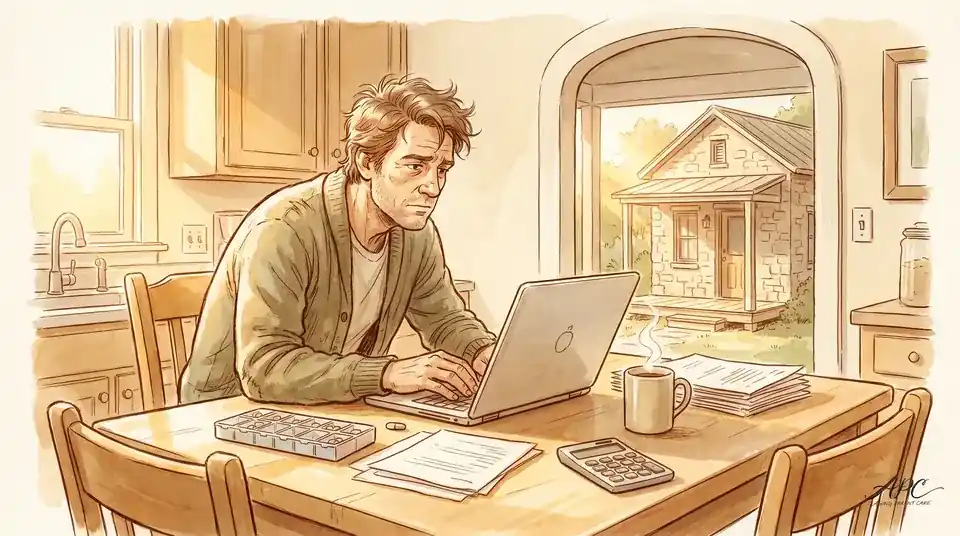

What Does Caregiver Burnout Feel Like? 7 Symptoms Families Mistake for Stress

Margaret ran a high school. Sixty-two staff, fourteen hundred students, and the kind of calm that made everyone assume she had it handled. When her mom's Parkinson's got worse, she did what she always did. She handled it. A year later she had lost fourteen pounds and stopped returning her friends' calls, and her assistant principal had quietly taken over the meetings she used to run. If your family is somewhere in that same stretch, here is the part almost no one says out loud: a small group of caregivers comes through it steadier, and what they do differently is something you can copy.
What Margaret was living through has a name, and it is not the same thing as being tired. Exhaustion is a resource problem; a real break fixes it. Burnout is a systems problem. The demands have outrun not just the energy but the sense that the energy would change anything if it were there. Exhaustion says, "I need a break." Burnout says, "a break will not fix this."
The numbers are blunt about how common this is. Roughly 78 percent of caregivers report feelings of burnout, many of them weekly or daily, and 87 percent say they hit stress and anxiety at some point.1 Family caregiving is also the quiet engine under the whole system: about 59 million people doing care worth more than a trillion dollars a year if anyone actually paid for it.2 Those figures are easy to read and easy to feel buried by. The number worth sitting with is a smaller one.
What about the caregivers who do not burn out?
About 22 percent of caregivers do not report burnout.1 It is tempting to assume they have it easier: more money, simpler medical needs, a parent who is less far along. The math does not back that up. Their situations are not lighter. They are doing something different inside the same hard situation.
Across the caregivers who held steady, three things kept turning up. None of them is a grand life change. Each one is small enough to build this week.
- A decision filter. One sheet of paper listing the five or six situations that come up most, with what to do about each. If Mom refuses her medication, here is what you try first. If she falls and is not hurt, here are the steps. Every decision pulled out of the crisis moment is one less fracture point in the day.
- A boundary. Not a wellness-poster boundary, a structural one: a single thing they will not do, set in advance. David kept his phone on silent between eleven at night and six in the morning, with his mother's facility holding the number for true emergencies only. It was a rule, and rules are easier to keep than decisions are to make at midnight.
- A person. Not always a therapist, though some had one. One other human who got the specific texture of what they were carrying. The conversations were often short. Ten minutes. Sometimes just a text that said "today was bad" and a reply that said "yeah."
What the steadier 22 percent built
- A decision filter. A written protocol for the handful of problems that keep recurring.
- A structural boundary. One thing they will not do, set in advance and kept as a rule.
- One person. Someone who gets the specific texture of it, even for ten minutes a week.

The free Aging Parent Care Starter Kit walks you through the first steps in plain language, at your own pace. Get it sent straight to your inbox.
Send me the free Starter KitHow do you actually build these three things?
Margaret built all three, and she did it on a Tuesday with a whiteboard, not after a retreat. Here is the order she went in, which is a reasonable order for anyone:
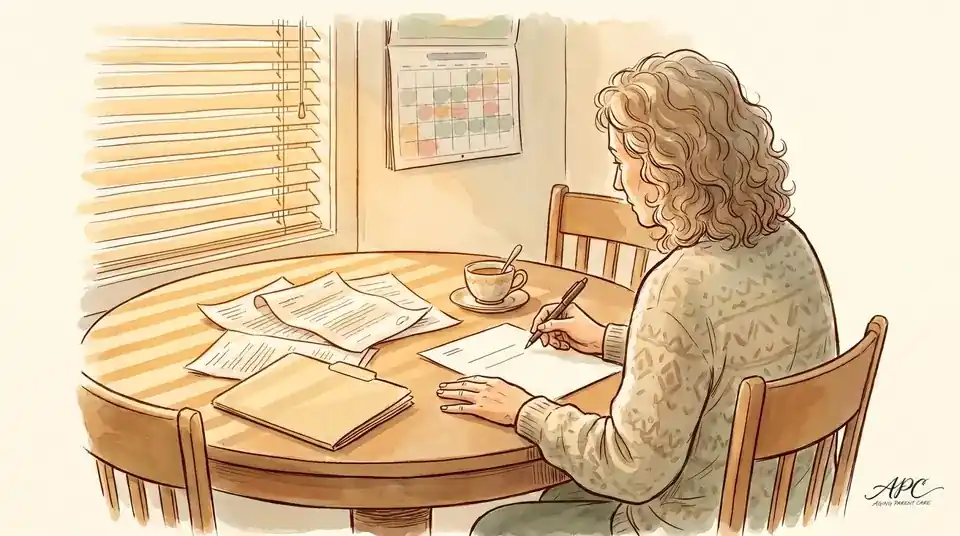
- Write down the six problems that derail most weeks, and next to each one write a single protocol for what to try first. That is the decision filter.
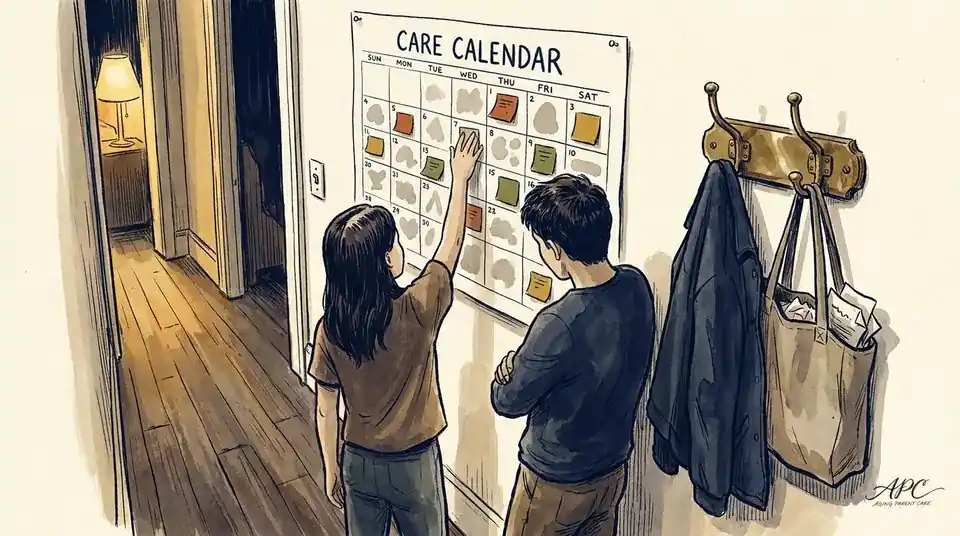
- Pick one boundary you can defend, and state it as a schedule rather than a request. Margaret told her brother James she needed him to take their mom every other weekend, framed as a plan, not a favor.
- Find one person who knows the terrain. Margaret found another principal whose father had Lewy body dementia, and they started having lunch on Thursdays.
I kept waiting to feel better. What I actually needed was to stop making the same forty decisions every week. Once I did that, the feeling better part just sort of happened on its own.
Margaret, family caregiver
What if you are also raising kids at the same time?
This is the part that is hard to say plainly. About one in four family caregivers, 24.3 percent, are also raising a minor child, and 44 percent of them describe the emotional difficulty as substantial, against 32 percent of caregivers without kids at home.3 Not stressful. Not hard. Substantial.
For families caught between an aging parent and young children, these three structures matter more, not less. There is no margin to power through, and there are people in the house who need the caregiver still standing at the end of it. The country has handed a trillion dollars of care to families and offered a pamphlet about self-care in return. No single family can fix that, and no single family caused it. What one family can do is build the smallest of the three structures first.
7 symptoms families write off as "just stress"
Burnout rarely announces itself. It shows up as a handful of small changes that look, one at a time, like an ordinary bad stretch. Together they are the pattern.
- Exhaustion that sleep doesn't fix.
- A short fuse: irritability or anger that surprises you.
- Pulling away from friends and things you used to enjoy.
- Getting sick more often, or staying sick longer.
- Resentment toward the parent you're caring for.
- Trouble concentrating or remembering.
- Flatness, the sense that nothing you do matters.
The three that need a doctor, not a day off: persistent hopelessness, being unable to function day to day, or any thought of self-harm. If those show up, that is a medical issue, and it is treatable.
How to recover
- Book one non-negotiable break a week and protect it like an appointment.
- Ask your Area Agency on Aging about respite care and respite vouchers; most families don't know these exist.
- Trade the impossible standard for "good enough." Care that's sustainable beats care that's perfect for a month and then collapses.
- If three or more symptoms last more than two weeks, get the medical evaluation (see the guide on when burnout becomes clinical depression).
Frequently Asked Questions
Is caregiver burnout the same as being tired?
No. Exhaustion is a resource problem that a real break can fix. Burnout is a systems problem: the demands have outrun the sense that effort will change the outcome. That is why a weekend off helps with one and not the other, and why the fix for burnout is usually structural rather than restful.
Do the caregivers who avoid burnout just have easier situations?
Not on average. The roughly 22 percent who do not report burnout do not have more money, simpler medical needs, or less advanced cases as a rule. They tend to have built repeatable structures around themselves: a decision filter, a boundary, and one person who understands the situation.
Where do I start if I only have time for one thing?
Start with the decision filter, because it gives time back fastest. Write the six problems that recur most often and a first step for each. Most of the daily load is making the same handful of decisions over and over, and writing them down once removes that weight from every future day.
Margaret never did get a calmer year. What she got was a whiteboard with six protocols on it, a brother who took every other weekend, and a Thursday lunch. The Parkinson's kept progressing. She just stopped making the same forty decisions twice. The steadier caregivers did not have lighter situations; they built something small around themselves, and picking the smallest one is enough for this week. Start your decision filter today with the free Aging Parent Care Starter Kit, which gives you a place to write the recurring problems and the family rotation in one spot.
Was this article useful?
Got feedback?
Let us know what was useful, unclear, or missing.
Related from Aging Parent Care
- Caregiver Guilt and Asking for Help
- How to Build a Care Team When You Are the Only One
- When Caregiving Burden Becomes Depression
Sources
- A Place for Mom. "Caregiver Burnout and Stress Statistics." aplaceformom.com/caregiver-resources/articles/caregiver-burnout-statistics
- AARP. "Valuing the Invaluable 2026 Update: Family Caregivers Account for $1 Trillion in Essential Care." aarp.org/caregiving/financial-legal/valuing-the-invaluable-report-2026
- Lei L, Leggett AN, Maust DT. "A National Profile of Sandwich Generation Caregivers Providing Care to Both Older Adults and Children." Journal of the American Geriatrics Society, 2022 (PMC). pmc.ncbi.nlm.nih.gov/articles/PMC10023280
This content is for educational and informational purposes only. It is not a substitute for professional medical, legal, or financial advice. Always consult qualified healthcare providers, attorneys, or financial advisors for guidance specific to your situation. Statistics and policy details cited were accurate at the time of publication and may have changed.
© 2026 Aging Parent Care. All rights reserved. No portion of this article may be reproduced, distributed, or used in any form without the explicit written permission of Aging Parent Care.
Keep reading
- Why You're Grieving a Parent Who's Still Alive
- The Guilt That Keeps You From Asking for Help
- You're the Only One Caring for Your Parent? How to Build a Team Anyway
- Why Won't Your Siblings Help With Your Aging Parent?
- Caregiver Rage Is Normal. Here's How to Handle It Without Guilt.
Burnout drops when the job gets a structure. The Complete Aging Parent Caregiving Guide covers the full arc in 30 chapters, and the Guide and Workbook together add the fillable templates families use to put it into practice.
Make Your Business Online By The Best No—Code & No—Plugin Solution In The Market.
30 Day Money-Back Guarantee
Say goodbye to your low online sales rate!