
Caregiver Rage Is Normal. Here's How to Handle It Without Guilt.

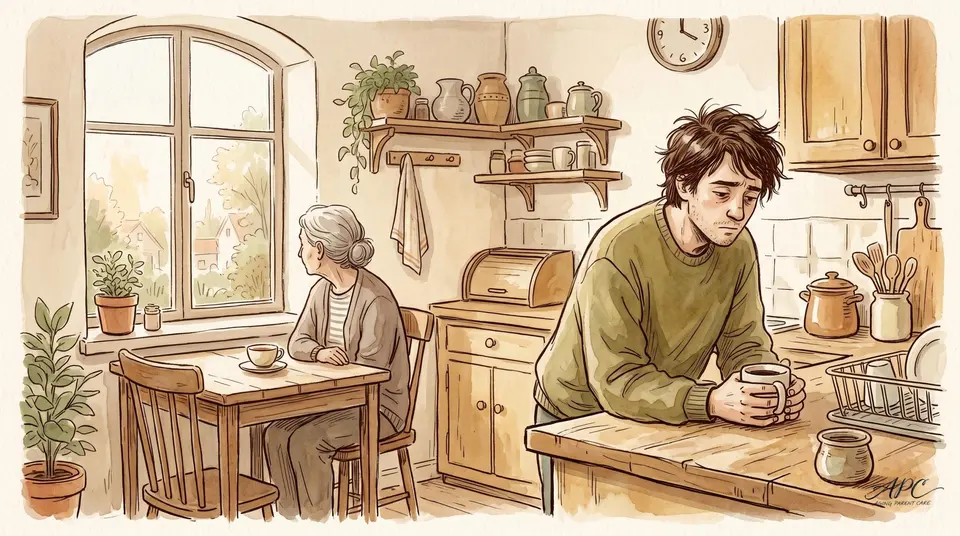
The pill cup hit the kitchen floor and the little blue tablet rolled under the fridge, and Renee heard herself snap at her father in a voice she did not recognize. He had knocked it out of her hand for the third morning that week. By the time she was on her knees with a flashlight, the anger had already curdled into the worse feeling, the one nobody warns you about: he is sick, he did not mean it, and you yelled at him anyway. Anger at a parent you love is one of the most common things in caregiving and one of the most hidden. Here is what doctors who study it actually find, why feeling rage is not the same as doing harm, and the moves that take the charge out of it.
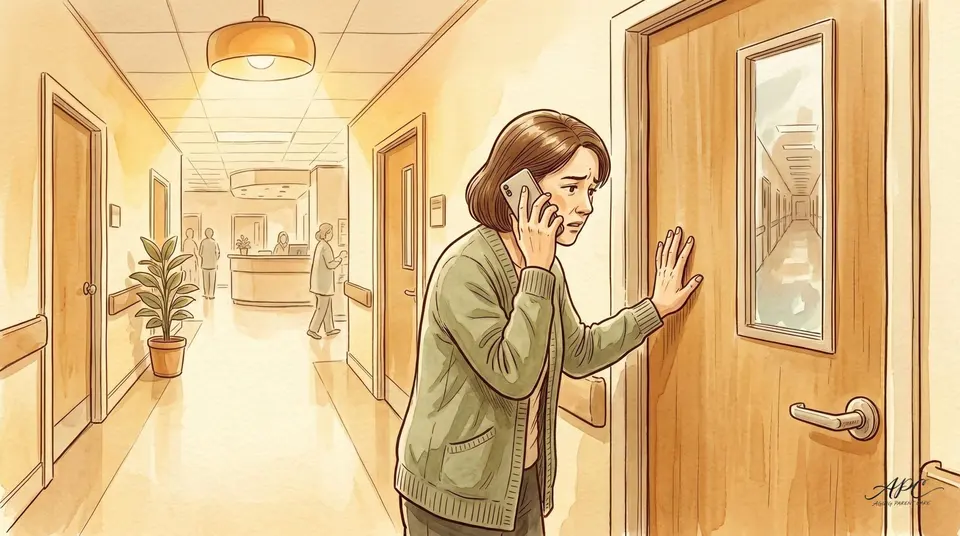
Renee did not tell anyone about that morning, the same way she had not told anyone about the afternoon a month earlier when she screamed in a parking lot after a cardiology appointment got cancelled at the desk. She drove two blocks, pulled into a strip mall, and let it out until her throat hurt. Then she went home and made dinner and said nothing. That night she lay awake convinced she was the only daughter in the world who felt this way about a parent she would do anything for.
She wasn't, and it isn't close. The people who study caregiver mental health keep landing on the same finding: anger sits right at the center of it, and it goes underreported because so many caregivers read it as proof of a broken character.1 It isn't proof of anything except a hard, unrelenting job. Let me walk through where the anger comes from, why it scares people more than it should, and the four things that genuinely help.
What to know about caregiver anger
- It is common, not rare. Anger sits at the center of caregiver mental health, and the chronic stress of the role makes it likely.
- Anger and harm are different things. The great majority of caregivers who feel rage never hurt the person they care for.
- Suppression backfires. Pushing it down feeds the burnout that eventually makes caregiving unsustainable.
- Naming it changes it. Saying the feeling out loud to one trusted person shifts how it sits inside you.
- Therapy and peer support both have a real evidence base, and Medicare covers mental health services.
Why does caring for a parent make you so angry?
Start with the part that surprises people: anger is not a side issue in caregiving, it is one of the things researchers put at the dead center of caregiver mental health.1 Caregivers run hot because the stress never lets up. The to-do list never empties, the sleep is short, and the person on the other end of it is someone you love and cannot fix.
Here is the distinction worth holding onto, the one that lets Renee breathe. Feeling rage and harming someone are not the same thing. The same research that flags anger as central treats it as a warning light, not a verdict, and the great majority of family caregivers who feel furious never lay a harmful hand on the person in their care.1 That gap matters, because the shame about the anger is exactly what keeps people from dealing with it.
Anger also has plain, nameable sources. Counselors who work with caregivers list the usual suspects: feeling overwhelmed, feeling out of control, going without sleep, watching a parent's abilities slip away with nothing you can do to stop it, and the slow build of resentment when the caregiving is split unevenly across a family.2 Not one of those is irrational. They are the anger telling you something true.
The kinds of anger nobody says out loud
There are at least three flavors of this that rarely get spoken:
- Anger at the parent for things they cannot help. The spilled pill cup. The same question asked four times in ten minutes. You know it is the illness and not a choice, and the anger rises anyway, and then you feel guilty for the anger. That two-step is something a lot of dementia caregivers describe. It turns out how you read the behavior matters: caregivers who can hold a parent's actions as a symptom rather than a deliberate act tend to feel less anger about them.4
- Anger at the siblings who do less. The labor almost never splits evenly, and the one carrying the most has a real grievance, not a petty one. That anger is information about a genuine imbalance, and it deserves to be heard rather than swallowed.
- Anger at the whole situation. The diagnosis, the insurance hold, the cancelled appointment, the sheer dumb arbitrariness of it. This is often the purest kind and the hardest, because there is no single face to aim it at.
The anger isn't rare. The silence around it is.
The free Aging Parent Care Starter Kit walks you through the first steps in plain language, at your own pace. Get it sent straight to your inbox.
Send me the free Starter KitWhat actually helps?
The thread running through the clinical advice is consistent: suppression does not work, and it quietly escalates into burnout. What works is letting the feeling exist, keeping it separate from any action, and giving it somewhere to go. Four moves carry most of the weight.
- Get it out of your body. Stepping away from the moment, the parking lot, the back porch, a brisk walk around the block, gives the anger somewhere to land that is not a person. Physical activity that gets the heart up is one of the better-supported ways to bleed off anger, and it is the closest thing to a fast fix there is.
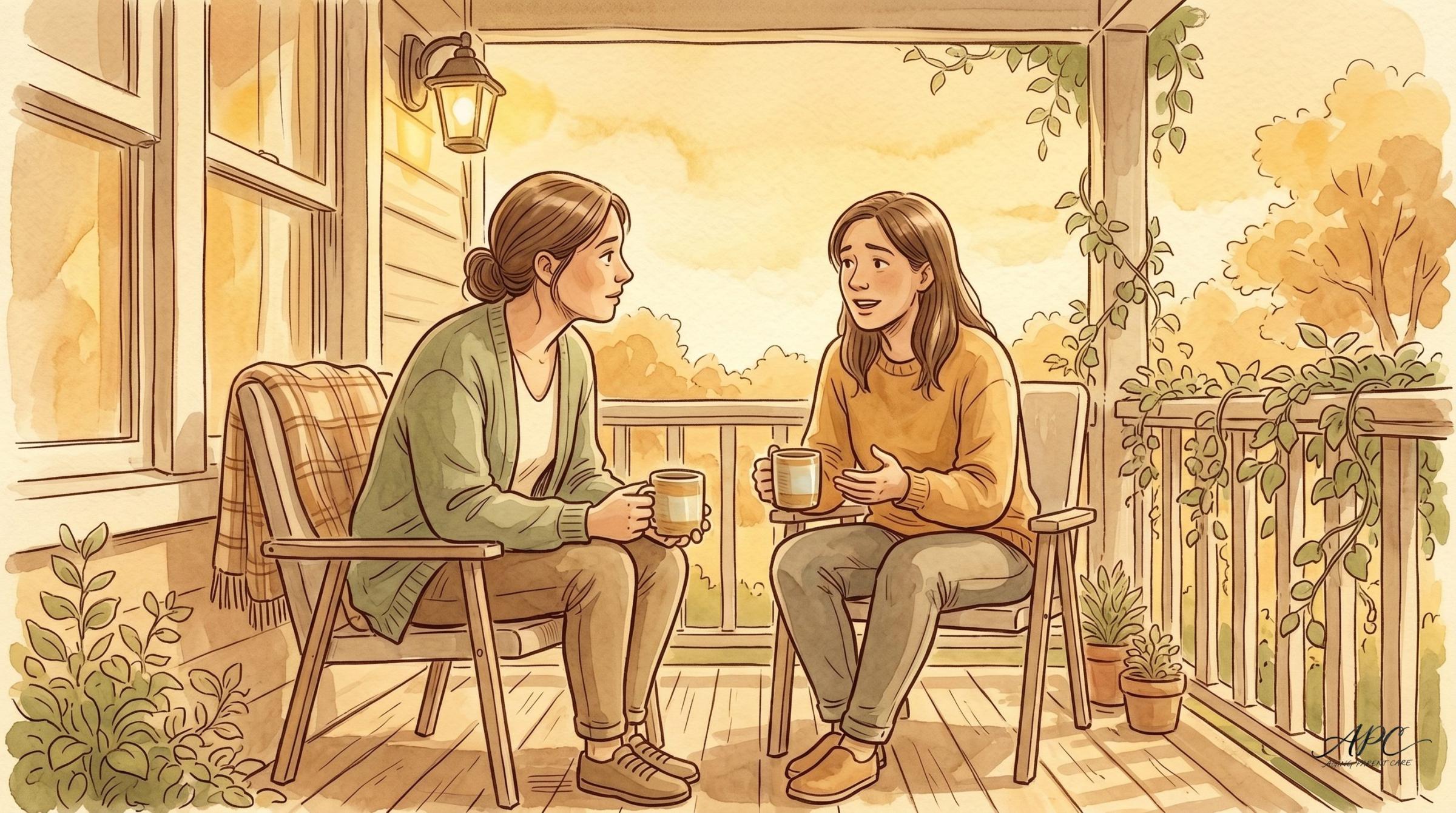
- Say it out loud to someone. Telling one trusted person "I am angry about this," a therapist, a support group, a friend, changes how the feeling sits in you. It is the difference between being swept along by anger and standing next to it long enough to hear what it is pointing at.3
- Use therapy on purpose. Cognitive behavioral therapy has a solid track record with caregivers, plenty of therapists now work over video, and Medicare covers mental health visits. The reframe it offers, from "I am angry, so I am a bad person" to "I am angry because this is genuinely hard," is simple to say and very hard to reach alone.
- Find people in the same boat. The real value of a caregiver support group is not tips and tricks. It is sitting in a room, or a video call, and learning that other people feel the exact thing you were sure made you a monster, and that it does not.5
The part that finally helped Renee
Months after the pill cup, Renee told her daughter about it, half-expecting to be looked at differently. Her daughter went quiet, then admitted she had her own version, a slammed door during a hospital stay she had carried alone for years. So did Renee's aunt, who had nursed her own mother through the end. Three generations of one family, the same buried morning, each one sure she was the only one.
That is the part worth sitting with. The anger was never the rare thing. The silence was. Renee's father, for what it is worth, has no memory of the pill cup at all, and still tells the same three stories at dinner, and still wins most arguments. The relationship survived the worst morning of it. It usually does.
Frequently Asked Questions
Does feeling angry at my parent mean I'm a bad caregiver?
No. Anger shows up as a central, expected part of caregiver mental health, driven by the relentless stress of the role. Feeling rage and acting on it are different things, and the great majority of caregivers who feel anger never harm the person they care for.
Is it normal to be angry at a parent with dementia?
Yes, and it is one of the most common things dementia caregivers describe. Knowing a behavior is a symptom and not a choice does not stop the anger from rising. How you interpret the behavior, as deliberate or as illness, affects how strongly the anger lands.4
What is the fastest thing that helps in the moment?
Discharge it physically. Step out of the situation and move your body. Over time, naming it to a trusted person, using therapy, and joining a peer group do the deeper work. Suppression is the one approach the advice consistently agrees does not help.
Caregiver anger is a symptom of an unrelenting role, not a verdict on anyone's character, and naming it is what takes the power out of it. Say the thing you are most ashamed to admit to one trusted person this week, and for a structured way to set up the supports that keep caregiving sustainable, start with the free Aging Parent Care Starter Kit.
Was this article useful?
Got feedback?
Let us know what was useful, unclear, or missing.
Related from Aging Parent Care
- 78% of Caregivers Report Burnout
- The Guilt That Keeps You From Asking for Help
- A Guide to Anticipatory Grief
Sources
- Macneil G, Kosberg JI, Durkin DW, et al. "Caregiver Mental Health and Potentially Harmful Caregiving Behavior: The Central Role of Caregiver Anger." The Gerontologist, 2010. pubmed.ncbi.nlm.nih.gov/19574537
- TheKey. "Ask the Expert: How to Cope with Anger as a Family Caregiver." thekey.com/resources/learning-center/learning-for-families/cope-family-caregiver-anger
- Healthline. "Caregiver Anger: What It Is and How To Manage It." healthline.com/health/senior-health/caregiver-anger
- Wang H, Cui H, Wang M, Yang C. "What You Believe Can Affect How You Feel: Anger Among Caregivers of Elderly People With Dementia." Frontiers in Psychiatry, 2021. pmc.ncbi.nlm.nih.gov/articles/PMC8058189
- Blue Moon Senior Counseling. "7 Tips for Coping With Caregiver Anger." bluemoonseniorcounseling.com/7-tips-for-coping-with-caregiver-anger
This content is for educational and informational purposes only. It is not a substitute for professional medical, legal, or financial advice. Always consult qualified healthcare providers, attorneys, or financial advisors for guidance specific to your situation. Statistics and policy details cited were accurate at the time of publication and may have changed.
© 2026 Aging Parent Care. All rights reserved. No portion of this article may be reproduced, distributed, or used in any form without the explicit written permission of Aging Parent Care.
More on the emotional side of caregiving
- How to Keep a Far-Away Parent From Slipping Into Loneliness
- Who Gets the Dog? How to Plan for Your Parent's Pet Before a Crisis
- Why You're Grieving a Parent Who's Still Alive (and How to Carry It)
- How to Get Power of Attorney for an Elderly Parent, Step by Step
- What Does Caregiver Burnout Feel Like? 7 Symptoms Families Mistake for Stress
The Complete Aging Parent Caregiving Guide covers the full caregiving arc in 30 chapters, and the Guide and Workbook together add the fillable templates families use to put it into practice.
Make Your Business Online By The Best No—Code & No—Plugin Solution In The Market.
30 Day Money-Back Guarantee
Say goodbye to your low online sales rate!