


Your Parent's Dementia Diagnosis Just Changed. Here Is What the New Drugs Actually Do.

Maya read the word "lecanemab" off her phone in the neurologist's parking lot before she ever said it out loud. Her father, Daniel, had just been told he had early Alzheimer's, the mild kind, caught while he could still tell the story of how they got there. And there was a drug now. An actual approved drug that slowed it down. For about ten minutes in that car she let herself feel something close to relief, the first in months. Then she started reading the rest, the infusions every two weeks, the brain scans, a side effect with a name she had to sound out, and a price tag that made her stomach drop.
So here is the honest version, the one she wished someone had handed her in that parking lot. The new Alzheimer's drugs are real, and they do something, and what they do is narrower and harder than the headlines make it sound. Once you know the actual numbers, the conversation with the neurologist gets a lot clearer, and the decision starts to feel like yours to make instead of one happening to you.
First, the part that is genuinely good news. After years of nothing that touched the disease itself, there are now two drugs that do. Both are for early-stage Alzheimer's only, the window Daniel happened to be in. Neither one cures anything. What they do is slow the slide, and the slowing is measured in months of holding steadier, not in getting anything back.
The two drugs are lecanemab, sold as Leqembi, and donanemab, sold as Kisunla. They work the same basic way: they are lab-made antibodies that clear amyloid, the sticky protein that builds up in the brain in Alzheimer's. Clearing it does not undo the damage already done. It appears to slow how fast the next damage arrives.
What the new Alzheimer's drugs actually do
- They slow, they do not cure. Lecanemab slowed decline by about 27 percent and donanemab by up to roughly 35 percent over 18 months versus placebo, at the mild stage only.
- Early stage is the whole ballgame. Both are approved only for mild cognitive impairment or mild Alzheimer's, confirmed by an amyloid test. Later-stage dementia is not eligible.
- It is an infusion plus monitoring. Regular IV infusions and repeated MRIs to watch for a brain-swelling and bleeding side effect called ARIA.
- Genes change the risk. People who carry two copies of the APOE4 gene face a higher ARIA risk, so genetic testing comes first.
- Cost is real even with Medicare. List prices run about $26,500 to $32,000 a year; Medicare Part B covers it through a registry, but copays can still run into the thousands.
How much do they actually slow it down?
This is the number Maya kept coming back to, because it is the one that decides whether the rest is worth it. In the big lecanemab trial, people on the drug declined about 27 percent more slowly over 18 months than the people on placebo.1 Donanemab, in its own trial, slowed decline by up to roughly 35 percent over the same stretch in patients whose disease was caught earlier.2
Here is the part the percentages hide. Slowing decline by a quarter or a third does not mean your parent loses a quarter or a third less of who they are. It means that at the 18-month mark, the gap between them and where they would have been is modest, often described by doctors as a handful of extra months at the milder stage. For some families that is a real gift. For others, weighed against the infusions and the risk, it is not enough. Both reactions are reasonable. The drug does what it does; what it is worth is a judgment only your family can make.
Who is even eligible?
This is where a lot of families hit a wall, and where Daniel got lucky on timing. Both drugs are approved only for the earliest part of the disease: mild cognitive impairment caused by Alzheimer's, or mild Alzheimer's dementia, with the diagnosis confirmed by a test showing amyloid in the brain.3 If a parent is already in the moderate or severe stage, these drugs are not an option, and no amount of pushing changes that. It is one of the hardest things to hear at a later diagnosis.
Before anyone starts, the neurologist will want proof of amyloid, usually a PET scan or a spinal fluid test, and a genetic test. The questions worth bringing to that first appointment are concrete:
- Is my parent in the early stage the drug is approved for, and how do we confirm it?
- What is my parent's APOE4 status, and how does it change the risk for them specifically?
- What does the infusion and MRI schedule look like month to month, and who drives them there?
- What will this cost us out of pocket on our exact Medicare or insurance plan, in dollars?
A new diagnosis brings a hundred decisions at once. The free Aging Parent Care Starter Kit walks you through the first steps in plain language, at your own pace. Get it sent straight to your inbox.
Send me the free Starter KitWhat is ARIA, and how worried should you be?
ARIA stands for amyloid-related imaging abnormalities, which is the clinical name for the drug causing swelling or small bleeds in the brain. It is the reason for all the MRIs. Most of the time it shows up on a scan with no symptoms and is managed by pausing or stopping the drug. Sometimes it causes headaches, confusion, or vision changes, and in rare cases it has been serious. In the donanemab trial, three deaths were linked to ARIA complications.2 In the lecanemab trial, swelling showed up in about 13 percent of patients and small bleeds in about 17 percent, most without symptoms.1
The risk is not the same for everyone, and this is where the genetic test matters. People who carry two copies of the APOE4 gene have a notably higher chance of ARIA, which is why the FDA-approved labels say to test APOE status before starting and why that result should shape the conversation.4 When Daniel's test came back with one copy rather than two, his neurologist framed the risk as real but manageable with monitoring. For a parent who carries two copies, that talk needs to be longer and more cautious, and walking away is a legitimate answer.
The drug is not a miracle and it is not a scam. It is a real, modest slowing that comes with real cost and real risk, and your family gets to decide if that trade is worth it.
What does it cost, and does Medicare pay?
Lecanemab's list price runs about $26,500 a year. Donanemab runs roughly $32,000, though Eli Lilly has said some patients can stop once their amyloid clears, which can shorten the course.5 Medicare Part B does cover both, but only when the patient is enrolled in a national registry that tracks how they do, and that registry step is not optional.6
Covered does not mean free. Without supplemental coverage, a patient is generally responsible for 20 percent of the cost, which with the infusion and monitoring added in can climb into the thousands per year.7 For a parent with a Medigap plan or Medicare Advantage, the out-of-pocket number swings widely. The single most useful thing you can do is call the plan and ask for the dollar figure before the first infusion, not after the first bill lands.
When the answer is no, and that is still care
Plenty of thoughtful families look at the modest slowing, the every-two-week infusions, the scans, and the cost, and decide it is not the right fit for their parent. That is not giving up. Saying no to one treatment is not saying no to your parent. Good dementia care has always been mostly about safety, routine, connection, and support for whoever is doing the caregiving, and none of that depends on a drug. Daniel was the one who said it plainest: he wanted to try, but he wanted Maya to promise that if the scans got scary, they would stop without a fight. That was his call to make, and she kept the promise.
Frequently Asked Questions
Do these drugs reverse or cure Alzheimer's?
No. Both lecanemab and donanemab slow how fast the disease progresses at the early stage; they do not reverse damage already done and they do not cure it. The benefit measured in trials was a slowing of decline of about 27 to 35 percent over 18 months, which works out to a modest amount of extra steadier time, not a return of lost abilities.12
Can my parent take them if their dementia is more advanced?
No. Both are approved only for mild cognitive impairment or mild Alzheimer's confirmed by an amyloid test.3 A parent in the moderate or severe stage is not eligible, which is one reason an early, confirmed diagnosis matters so much for families weighing this choice.
How dangerous is the ARIA side effect?
For most patients ARIA shows up on a routine scan with no symptoms and is handled by pausing the drug, but it can occasionally be serious, and three deaths in the donanemab trial were linked to it.2 The risk is higher for people who carry two copies of the APOE4 gene, which is why genetic testing comes before treatment and shapes the decision.4
Will Medicare pay for it?
Medicare Part B covers lecanemab and donanemab for eligible early-stage patients, but only when they are enrolled in a CMS-approved registry.6 Even with coverage, copays can reach into the thousands a year without supplemental insurance, so confirm the exact dollar amount with your parent's specific plan first.7
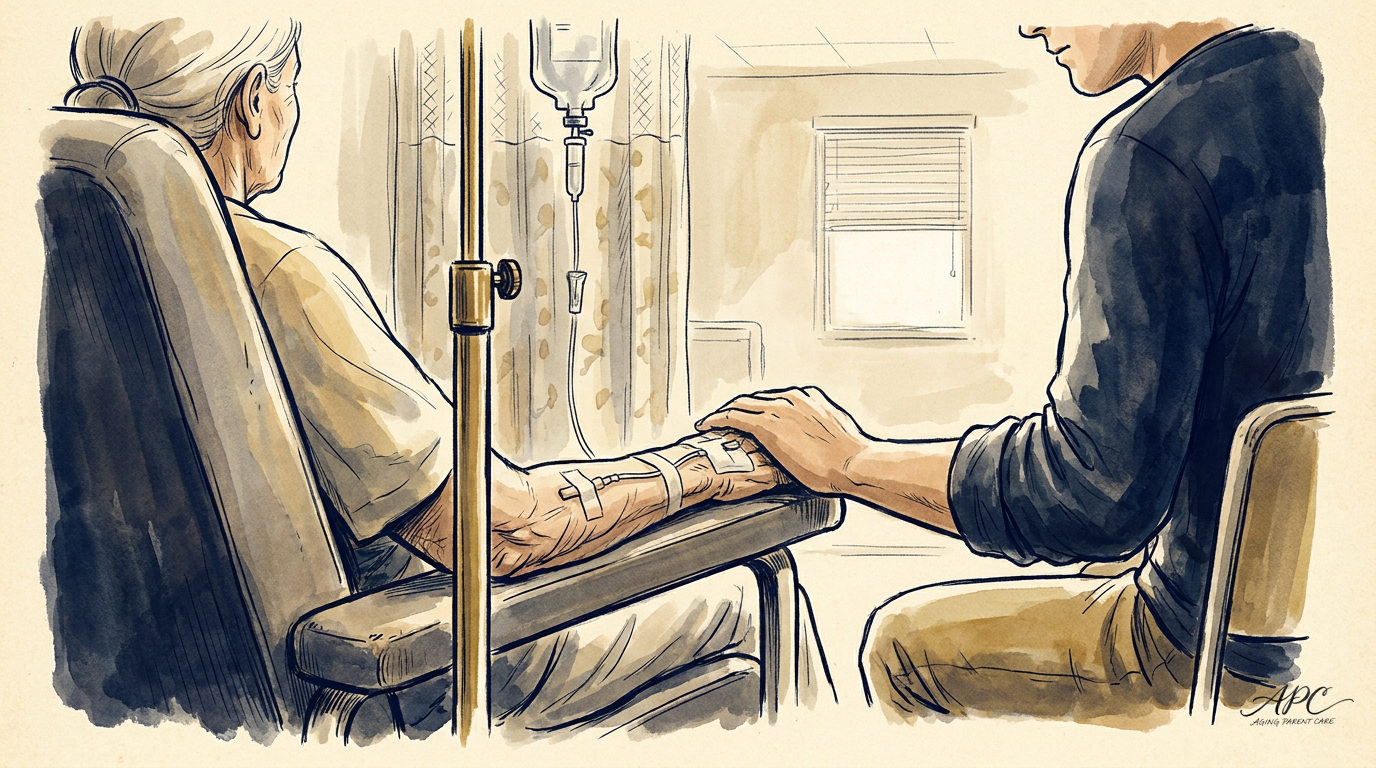
Daniel started his first infusion on a Thursday, with Maya in the chair beside him and a coffee neither of them really drank. The early scans came back clean. He knows the slowing is small and that the scary part could still come. But he also knew exactly what he was choosing, and so did she, and that turned out to matter as much as the drug itself.
The new Alzheimer's drugs are a genuine first step, and a narrow one: a modest slowing at the early stage, paid for in infusions, scans, real risk, and real money. The families who decide well are the ones who get the actual numbers first. Before your next neurologist visit, write down your parent's stage, ask for their APOE4 status, and call the insurance plan for the out-of-pocket dollar figure. The free Aging Parent Care Starter Kit gives you a plain-language place to start organizing it all.
Was this article useful?
Got feedback?
Let us know what was useful, unclear, or missing.
Related from Aging Parent Care
- The Dementia Signs That Don't Look Like Dementia
- 2026 Medicare Changes Before Open Enrollment
- The Algorithm Deciding Whether Your Parent Gets Treatment
Sources
- van Dyck CH, et al. "Lecanemab in Early Alzheimer's Disease." New England Journal of Medicine, 2023. nejm.org/doi/full/10.1056/NEJMoa2212948
- Sims JR, et al. "Donanemab in Early Symptomatic Alzheimer Disease: The TRAILBLAZER-ALZ 2 Randomized Clinical Trial." JAMA, 2023. pubmed.ncbi.nlm.nih.gov/37459141
- U.S. Food and Drug Administration. "Drug Trials Snapshots: LEQEMBI." fda.gov/drugs/drug-approvals-and-databases/drug-trials-snapshots-leqembi
- Dean L, Kane M. "Lecanemab Therapy and APOE Genotype." Medical Genetics Summaries, NCBI Bookshelf, NIH. ncbi.nlm.nih.gov/books/NBK605938
- National Council on Aging. "Alzheimer's Medication Leqembi Now Covered by Medicare, But Access and Effectiveness Questions Remain." ncoa.org/article/alzheimers-medication-leqembi-now-covered-by-medicare
- Centers for Medicare & Medicaid Services. "Monoclonal Antibodies Directed Against Amyloid for the Treatment of Alzheimer's Disease (AD)." cms.gov/medicare/coverage/coverage-evidence-development/monoclonal-antibodies-directed-against-amyloid-treatment-alzheimers-disease-ad
- Alzheimer's Association. "Medicare Treatment Coverage for People Living With Alzheimer's." alz.org/alzheimers-dementia/treatments/cms-medicare-coverage
This content is for educational and informational purposes only. It is not a substitute for professional medical advice. Decisions about Alzheimer's treatment should be made with a qualified neurologist or physician who knows your parent's full history. Statistics, prices, and policy details cited were accurate at the time of publication and may have changed.
© 2026 Aging Parent Care. All rights reserved. No portion of this article may be reproduced, distributed, or used in any form without the explicit written permission of Aging Parent Care.
Related medical guides
- Your Parent's World Is Shrinking. Before You Blame Age, Check Their Eyes.
- Why Your Aging Parent Can't Sleep, and How to Help Them Rest Again
- How to Catch Malnutrition Before It Lands Your Parent in the Hospital
- How to Get Power of Attorney for an Elderly Parent, Step by Step
- What Does Caregiver Burnout Feel Like? 7 Symptoms Families Mistake for Stress
The Complete Aging Parent Caregiving Guide covers the full caregiving arc in 30 chapters, and the Guide and Workbook together add the fillable templates families use to put it into practice.
Make Your Business Online By The Best No—Code & No—Plugin Solution In The Market.
30 Day Money-Back Guarantee
Say goodbye to your low online sales rate!